
Best Temples in Bangkok: The Ultimate Comprehensive Guide to Thailand’s Sacred Wonders (2026 Edition)
Bangkok, officially known as Krung Thep Maha Nakhon, is one of the most vibrant and culturally rich capitals in Southeast Asia. Often called the City of Angels, this sprawling metropolis is home to more than 400 Buddhist temples, or “wats,” that serve as the spiritual heartbeat of Thai society. These sacred sites are not just architectural masterpieces — they are living monasteries, centers of learning, community hubs, places of merit-making, and profound symbols of Thailand’s deep-rooted Theravada Buddhist heritage.
For many travelers, exploring the best temples in Bangkok is one of the main reasons to visit Thailand’s capital. From royal temple complexes to quieter local wats, the city offers some of the most impressive religious landmarks in Southeast Asia.
If you are visiting the Thai capital for the first time, you may also want to read our complete Bangkok travel guide which explains where to stay, how to get around the city, and what to see in Bangkok.
From the dazzling opulence of the Grand Palace and Wat Phra Kaew to the serene majesty of the Reclining Buddha at Wat Pho, the iconic riverside silhouette of Wat Arun, and countless hidden gems tucked away in quiet neighborhoods or along historic canals, Bangkok’s temples offer an incredible variety of experiences. Some are grand royal complexes tied directly to the Chakri dynasty, while others are modest local wats where everyday Thais come to pray, offer alms to monks, or simply find a moment of peace amid the city’s chaotic energy.
Bangkok is also one of the highlights featured in our guide to the best places to visit in Thailand, which covers the most spectacular destinations across the country.
Overview
- Understanding Bangkok’s Temple Culture and Thai Buddhism
- 1. Wat Phra Kaew and the Grand Palace – Thailand’s Most Sacred Royal Complex
- 2. Wat Pho – The Reclining Buddha Temple in Bangkok
- 3. Wat Arun – One of the Most Beautiful Temples in Bangkok
- 4. Wat Traimit – Temple of the Golden Buddha in Chinatown
- 5. Wat Suthat and the Giant Swing – A Blend of Buddhist and Hindu Heritage
- 6. Wat Saket – The Golden Mount (Phu Khao Thong)
- 7. Wat Ratchanatdaram – The Unique Metal Castle (Loha Prasat)
- 8. Wat Benchamabophit – The Marble Temple in Bangkok
- 9. Wat Indrawihan and Other Notable Sites
- Best Temples in Bangkok: How to Plan Your Temple Itinerary
Understanding Bangkok’s Temple Culture and Thai Buddhism
Buddhism arrived in what is now Thailand over a thousand years ago and has profoundly shaped the nation’s identity, art, ethics, and daily life. Today, more than 95% of Thais practice Theravada Buddhism, the oldest surviving school of Buddhism. Temples function as monasteries where monks study scriptures, meditate, and teach; as schools for both religious and secular education; as venues for festivals and ceremonies; and as places where locals make merit (tham bun) through donations, offerings, and acts of kindness.
Many of Bangkok’s most important temples trace their origins or major renovations to the Rattanakosin period, which began when King Rama I founded the new capital in 1782 after the destruction of Ayutthaya by Burmese forces in 1767. The architecture typically features multi-tiered roofs with upturned eaves, golden chedis (stupas) housing relics, towering prangs (spire-like towers) influenced by Khmer styles, intricate murals depicting the Ramakien (Thai adaptation of the Ramayana) or Jataka tales (previous lives of the Buddha), fierce guardian yaksha statues, and decorative elements using gold leaf, mirrored glass, porcelain shards, and mother-of-pearl inlays.
Visiting temples allows travelers to experience Thai values such as respect (khwam khaorop), humility, generosity, and mindfulness firsthand. It also provides a peaceful contrast to Bangkok’s bustling streets, markets, and traffic. Major festivals like Makha Bucha, Visakha Bucha, Asalha Bucha, and Khao Phansa transform temple grounds into vibrant centers of celebration with candlelit processions, chanting, and communal meals.
Essential Temple Etiquette and Practical Tips for 2026:
- Dress Code: Shoulders and knees must be fully covered. Avoid tight, short, or revealing clothing. Major sites like the Grand Palace strictly enforce this and may provide sarongs or pants for a small fee or deposit.
- Footwear: Always remove shoes before entering any main building, prayer hall, or sacred area.
- Behavior: Speak softly, do not point your feet toward Buddha images, monks, or sacred objects. Women should avoid physical contact with monks. Do not climb on statues or sit with your back to Buddha images.
- Best Visiting Times: Early morning (8–10 AM) to avoid heat and crowds, or late afternoon near sunset. Weekdays are significantly quieter than weekends and public holidays.
- Entry Fees: Major royal temples charge 100–500 THB for foreign visitors. Many smaller neighborhood wats are free or accept voluntary donations.
- Photography: Usually permitted in outer courtyards but often restricted inside main halls — always check signs or ask politely.
- Additional Advice: Consider making a small offering (incense, flowers, or candles) or donating to support the temple. Respect ongoing ceremonies and monastic routines.
1. Wat Phra Kaew and the Grand Palace – Thailand’s Most Sacred Royal Complex
The Grand Palace complex, located on Rattanakosin Island in the historic heart of Bangkok, is the city’s most iconic landmark and home to Wat Phra Kaew, officially known as Wat Phra Si Rattana Satsadaram or the Temple of the Emerald Buddha. Construction of the palace began on May 6, 1782, by order of King Rama I, the founder of the Chakri dynasty, shortly after he moved the capital from Thonburi to Bangkok for strategic and symbolic reasons.
The entire walled complex covers approximately 218,000 square meters (over 2.3 million square feet) and is surrounded by crenellated walls nearly 1,900 meters long. It served as the official royal residence and administrative center for more than 150 years until the early 20th century. Today it remains the setting for important state ceremonies, royal rituals, and receptions for foreign dignitaries, even though kings no longer reside there permanently.
The Emerald Buddha (Phra Kaew Morakot), a small but immensely powerful statue carved from a single piece of jadeite, standing only 66 centimeters tall. Legends trace its origins to the 15th century in northern Thailand or Laos. The statue has traveled through various kingdoms before being brought to Bangkok in 1784 with great ceremony. It is housed in an ornate gilded hall and dressed in seasonal gold robes changed three times a year by the King or Crown Prince — a ritual symbolizing protection and prosperity for the nation.
The temple and palace grounds feature breathtaking Thai architecture: soaring golden spires, colorful murals stretching for kilometers that depict the Ramakien epic, demon guardians (yaksha), intricate gold-leaf decorations, mirrored glass mosaics, and a blend of traditional Thai, Khmer, and later European neoclassical influences added during the reigns of subsequent kings, especially Rama IV and Rama V.
Key highlights include the Phra Ubosot (main ordination hall), the Royal Pantheon with statues of past Chakri kings, beautiful courtyards, and extensive gardens. The sheer scale, opulence, and spiritual importance make this a site that often leaves visitors speechless.
Practical Information for 2026: Open daily from 8:30 AM to 3:30 PM (last admission). Entry fee for foreigners is 500 THB, which includes access to the Grand Palace grounds and often an optional audio guide. Strict dress code is enforced at the entrance. Photography is generally allowed in the outer areas but prohibited inside the main Emerald Buddha hall. Plan to spend at least 2–3 hours exploring.
Because the Grand Palace is one of the most visited attractions in Thailand, entrance lines can become very long during peak hours. If you want to secure your visit in advance, you can check Grand Palace tickets and guided tours here.
This complex perfectly embodies the inseparable connection between the Thai monarchy and Theravada Buddhism, serving as both a national symbol and a place of profound spiritual reverence.
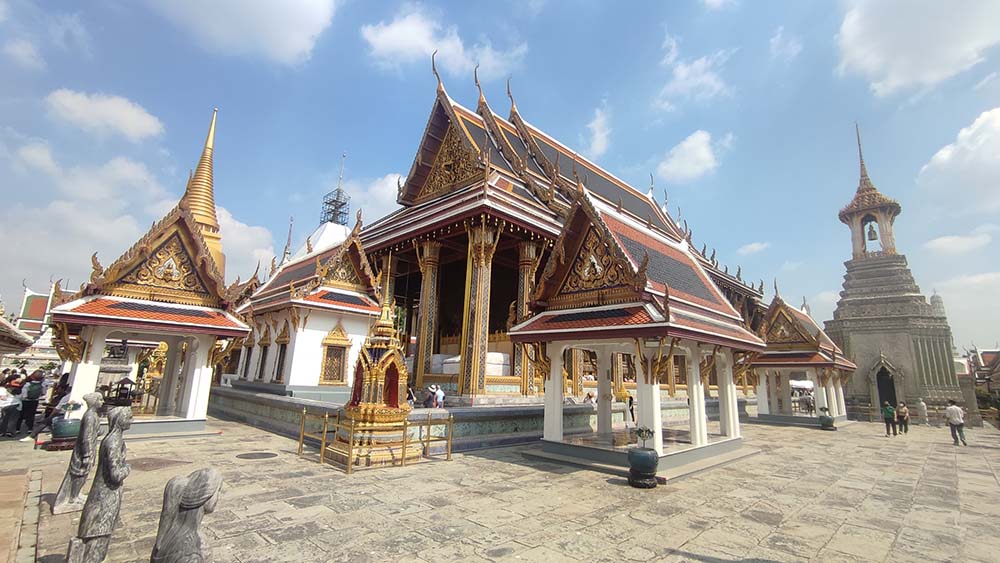
The Grand Palace, Bangkok, Thailand
2. Wat Pho – The Reclining Buddha Temple in Bangkok
Located immediately south of the Grand Palace, Wat Pho (full name Wat Phra Chetuphon Wimon Mangkhalaram Rajwaramahawihan) is one of Bangkok’s oldest and largest temples. Its history dates back to the 16th century during the Ayutthaya period, long before Bangkok became the capital. King Rama I significantly expanded and restored the site in the late 18th century, and King Rama III carried out a major renovation lasting over 16 years in the early 19th century.
The temple covers around 80,000 square meters and holds first-class royal temple status. It is best known for housing the enormous Reclining Buddha statue, which measures 46 meters in length and 15 meters in height. Covered entirely in shimmering gold leaf, the figure depicts the Buddha entering parinirvana (final nirvana) at the end of his earthly life. The soles of the feet are exquisitely inlaid with mother-of-pearl, featuring 108 auspicious symbols arranged in panels — including flowers, dancers, elephants, tigers, and other sacred motifs. The statue is so large that the hall was constructed around it.
Wat Pho also boasts the largest collection of Buddha images in Thailand, with hundreds of gilded statues in various poses housed across multiple chapels and viharas. Many of these were brought from ruined temples in Ayutthaya and Sukhothai after the 1767 invasion.
Beyond its religious importance, Wat Pho is recognized as the birthplace of traditional Thai massage. King Rama III established it as a center of learning for medicine, science, literature, and massage techniques. The on-site Thai Traditional Massage School and clinic continue to operate today, offering authentic treatments and training courses to both locals and international visitors.
The grounds feature colorful chedis of varying sizes, peaceful rock gardens, beautiful courtyards with bonsai-style trees, and inscribed stone tablets that once served as an early form of public education. The temple remains an active monastic community while welcoming respectful tourists.
Practical Information (2026): Open daily from 8:00 AM to 6:30 PM. Entry fee: 200 THB for foreigners. Massage services are available at additional cost. It is very easy to combine with a visit to the Grand Palace since the sites are adjacent. Wear comfortable clothing and be prepared for some walking on uneven surfaces.
More immersive options include Chao Phraya River boat tours, canal long-tail boat trips through Thonburi, or guided cycling/food tours that combine temples with local culture and cuisine. Hiring a knowledgeable English-speaking guide can greatly enrich your understanding of the history, symbolism, and living traditions.
Approaching these sites with respect and openness allows you to move beyond surface-level tourism and connect with the spiritual essence of Thailand. Many visitors find that time spent in Bangkok’s temples brings a sense of calm, reflection, and cultural appreciation that lingers long after returning home.
Whether you visit only three or spend several days exploring, the best temples in Bangkok offer one of the richest cultural experiences in Thailand.
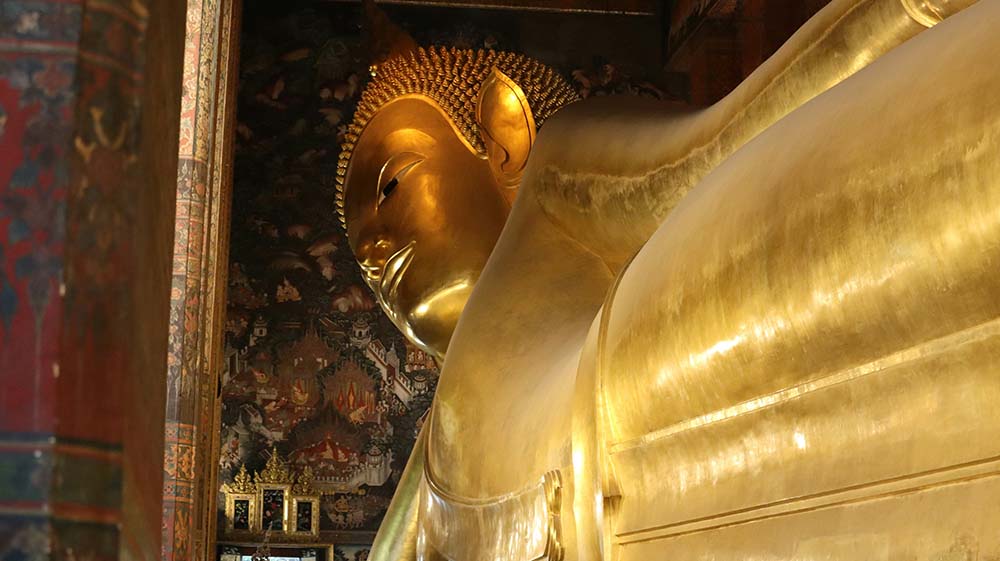
Wat Pho – The Reclining Buddha
3. Wat Arun – One of the Most Beautiful Temples in Bangkok
Standing majestically on the western bank of the Chao Phraya River in the Thonburi district, Wat Arun Ratchawararam (popularly known as Wat Arun or the Temple of Dawn) is one of Bangkok’s most photographed and recognizable landmarks. A temple has existed on this site since at least the 17th century during the Ayutthaya kingdom, but the current distinctive structure was developed primarily during the reigns of King Rama II and King Rama III in the early to mid-19th century.
The name “Temple of Dawn” derives from the Hindu god Aruna, personifying the first light of morning, though the temple looks equally spectacular at sunset when the warm light reflects off its surfaces. The central Khmer-style prang (tower) rises approximately 82 meters high and is encrusted with millions of pieces of colorful Chinese porcelain, seashells, and glazed tiles arranged in intricate floral and geometric patterns. These materials were originally used as ballast on trading ships from China.
The temple’s design symbolizes Mount Meru, the cosmic mountain at the center of the universe in Buddhist and Hindu cosmology. It features one main prang surrounded by four smaller satellite prangs, along with ordination halls, smaller shrines, and beautiful riverside views. Historically, during the short-lived Thonburi period under King Taksin, Wat Arun temporarily housed the Emerald Buddha after it was brought from Laos.
Visitors can climb the steep, narrow stairs of the main prang for panoramic views across the river to the Grand Palace and modern Bangkok skyline — a rewarding but physically demanding experience that requires comfortable shoes and caution, especially in wet weather.
Practical Information (2026): Open daily from 8:00 AM to 6:00 PM (sometimes later for sunset). Entry fee: approximately 100–200 THB. The easiest way to reach it is by Chao Phraya Express Boat or the short cross-river ferry from Tha Tien pier near Wat Pho. Sunset visits are particularly magical when the temple is illuminated.
Wat Arun is often visited together with Wat Pho because the two temples are located on opposite sides of the Chao Phraya River. If you plan to see both, you can book a combined Wat Pho and Wat Arun ticket here, which allows you to visit two of Bangkok’s most famous temples in one trip.

Wat Arun, Bangkok, Thailand
4. Wat Traimit – Temple of the Golden Buddha in Chinatown
Nestled in the energetic Samphanthawong district near Bangkok’s famous Chinatown (Yaowarat), Wat Traimit is famous worldwide for housing the largest solid gold Buddha statue in existence — Phra Phuttha Maha Suwanna Patimakon.
The statue stands about 3 meters tall, weighs 5.5 tons, and is crafted from approximately 83% pure gold. It dates back to the Sukhothai period (13th–14th century) but was cleverly concealed under a thick layer of stucco and colored glass for centuries to protect it from invaders and looters. Its true nature was only discovered accidentally in 1955 when the plaster cracked during a routine move, revealing the gleaming gold beneath.
The Buddha is depicted in the Maravijaya (victory over Mara) posture, symbolizing the moment of enlightenment. While the temple complex itself is relatively modest compared to the grand royal wats, the Golden Buddha draws large numbers of devotees who come to pay respects and seek blessings. The surrounding Chinatown area offers an excellent opportunity to combine your visit with vibrant street food, markets, and Chinese-Thai cultural experiences.
Practical Information: Open roughly 8:00 AM – 5:00 PM. Small entry fee (typically 40–100 THB). Easily accessible via MRT Hua Lamphong or by walking through Yaowarat Road.
5. Wat Suthat and the Giant Swing – A Blend of Buddhist and Hindu Heritage
Wat Suthat Thepwararam is another first-class royal temple in the historic old city. Construction began under King Rama I and was completed during the reign of King Rama III. It is renowned for its exceptionally fine 19th-century mural paintings inside the main ordination hall (ubosot), widely regarded as some of the most beautiful and detailed in Thailand.
The temple houses a large and revered Sukhothai-style bronze Buddha image. In the square in front stands the iconic Giant Swing (Sao Chingcha), a towering 21-meter red teak structure originally used in an ancient Brahmin-Hindu ceremony during the annual New Year rituals. Teams of young men would swing high into the air to catch coins or tokens with their teeth — a dangerous practice that was eventually discontinued due to fatal accidents.
The presence of the Giant Swing alongside grand Buddhist architecture highlights the historical syncretism of Hindu and Buddhist traditions in Thai royal culture.
Practical Information: Usually free or small donation requested. The Giant Swing itself is a popular spot for photos and is located near the Democracy Monument.
6. Wat Saket – The Golden Mount (Phu Khao Thong)
Wat Saket Ratchawora Maha Wihan, better known as the Golden Mount, is built on an artificial hill created in the early Rattanakosin period. The site originally served as a cremation ground and mass burial area after the fall of Ayutthaya. King Rama I and later kings restored and developed the temple.
The highlight is the golden chedi atop the roughly 80-meter hill, which is said to enshrine sacred Buddha relics brought from India and Sri Lanka. Climbing the 300+ steps through a peaceful walkway lined with bells offers sweeping panoramic views over Bangkok’s old city and modern skyline. The temple is especially atmospheric during festivals when thousands of candles and lanterns light the paths at night.
Practical Information (2026): Open daily approximately 7:00 AM – 7:00 PM. Small fee (around 100 THB) to access the chedi area. Located near Wat Ratchanatdaram — ideal to visit both in one trip.
7. Wat Ratchanatdaram – The Unique Metal Castle (Loha Prasat)
Built in 1846 during the reign of King Rama III, Wat Ratchanatdaram is famous for its extraordinary Loha Prasat (Iron or Metal Castle), a seven-story structure with 37 gilded spires representing the 37 virtues or factors leading to enlightenment in Buddhism. Inspired by ancient Indian and Sri Lankan designs that no longer exist elsewhere, this is the only remaining example of its kind in the world.
A spiral staircase allows visitors to ascend through the levels, culminating in a chamber said to house a Buddha relic. The temple was constructed to honor a royal family member and stands out dramatically against the more conventional Thai temple architecture.
Practical Information: Open daily 8:00 AM – 5:00 PM. Modest entry fee (20–50 THB). Situated on Maha Chai Road, opposite the Golden Mount.
8. Wat Benchamabophit – The Marble Temple in Bangkok
Constructed in the early 20th century under King Rama V (Chulalongkorn), Wat Benchamabophit Dusitwanaram is built almost entirely from white Carrara marble imported from Italy, giving it a bright, elegant, and distinctive appearance. The main ordination hall features a beautiful golden Buddha in the Sukhothai style, while the grounds include serene canals, manicured gardens, and long rows of identical Buddha statues sheltered under the eaves.
The temple is known for its disciplined monastic community and often hosts significant royal and religious ceremonies. Its clean lines and reflective marble surfaces make it particularly photogenic at sunrise or sunset.
Practical Information: Open 8:00 AM – 5:30 PM. Entry fee around 50–100 THB. Located in the Dusit district near other royal sites.
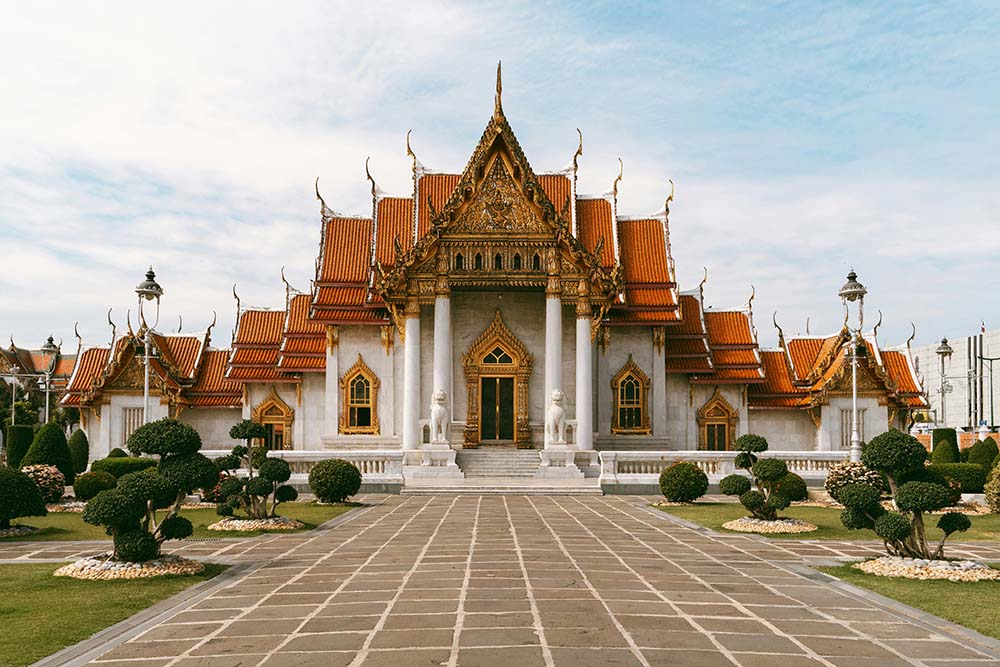
Wat Benchamabophit
9. Wat Indrawihan and Other Notable Sites
Wat Indrawihan (Wat Intharawihan) is known for its towering 32-meter Standing Buddha covered in gold mosaic tiles, one of the tallest such images in Bangkok. The complex offers a more local, less crowded atmosphere perfect for observing everyday devotional practices.
Additional temples worth exploring include Wat Mahathat (an important center for meditation and monastic education), Wat Paknam Bhasicharoen (famous for its giant modern Buddha and advanced meditation teachings), and Wat Rakhang Kositaram (a beautiful riverside temple with historic bells).
For truly hidden gems, venture into smaller neighborhood wats in areas like Thonburi canals or outer districts, where you can experience authentic local temple life with minimal tourists.
Best Temples in Bangkok: How to Plan Your Temple Itinerary
A classic one-day route starts early at the Grand Palace and Wat Phra Kaew, followed by a short walk to Wat Pho, then a ferry crossing to Wat Arun for sunset views.
If you plan to visit both temples, you can book a combined Wat Pho and Wat Arun ticket here, which is one of the easiest ways to visit two of the most famous temples in Bangkok in a single day.
For a two- or three-day experience, add Wat Traimit and Chinatown, Wat Suthat with the Giant Swing, the Golden Mount and Metal Castle, and the Marble Temple.
If you are short on time, focusing on the best temples in Bangkok is one of the easiest ways to experience the city’s culture, history, and architecture in just one or two days.
If you want to see the most important temples efficiently, follow this 3 day Bangkok itinerary which combines temples, markets, and viewpoints across the city.
More immersive options include Chao Phraya River boat tours, canal long-tail boat trips through Thonburi, or guided cycling/food tours that combine temples with local culture and cuisine. Hiring a knowledgeable English-speaking guide can greatly enrich your understanding of the history, symbolism, and living traditions.
Approaching these sites with respect and openness allows you to move beyond surface-level tourism and connect with the spiritual essence of Thailand. Many visitors find that time spent in Bangkok’s temples brings a sense of calm, reflection, and cultural appreciation that lingers long after returning home.
Whether you visit only three or spend several days exploring, the best temples in Bangkok offer one of the richest cultural experiences in Thailand.