
Algeria Travel Guide (2026) – Best Places to Visit, Visas, Money & Tips
Algeria is one of the largest countries in Africa, yet it remains one of the least visited travel destinations in the world. While millions of travellers flock to nearby Morocco or Tunisia every year, Algeria remains largely unexplored by international tourism. For adventurous travellers, however, this is exactly what makes the country so fascinating.
Stretching from the Mediterranean coastline all the way to the heart of the Sahara Desert, Algeria offers an incredible diversity of landscapes and historical sites. Along the northern coast you will find vibrant cities with Ottoman and French colonial architecture, lively markets and beautiful seaside promenades. Venture further inland and the scenery quickly changes to rugged mountains, ancient Roman ruins and vast high plateaus.
History lovers will find some of the most impressive Roman archaeological sites in North Africa. Cities such as Timgad and Djemila are among the best-preserved Roman ruins anywhere in the former empire. In Algiers, the capital, the historic Casbah rises above the Mediterranean with its maze of narrow streets, mosques and centuries-old houses.
Yet the greatest highlight of Algeria lies further south. Covering around 80 percent of the country, the Sahara Desert reveals dramatic landscapes of towering sand dunes, endless rocky plateaus and remote oases surrounded by palm groves. Regions such as Tassili n’Ajjer and the Hoggar Mountains offer some of the most surreal desert scenery on the planet.
From ancient cities and Mediterranean ports to vast Saharan landscapes, Algeria offers an extraordinary range of destinations waiting to be discovered. In this guide, we explore the best places to visit in Algeria and the remarkable locations that make this country one of North Africa’s most intriguing travel destinations.
Table of Contents
Best Time to Visit Algeria
The best time to visit Algeria is usually spring (March to May) and autumn (October to November), when temperatures are more comfortable across much of the country. These months are generally the most pleasant for combining northern cities, Roman ruins and desert regions in one trip.
If you plan to explore Algiers, Constantine, Oran or the Mediterranean coast, late spring and early autumn are especially enjoyable. The weather is typically warm without the intense heat of midsummer, which makes sightseeing much easier. Coastal trips are also popular between May and October for travellers who want sunnier conditions by the sea.
For trips focused on the Sahara Desert, the best period is usually from October to April or early May. During these months, daytime temperatures are much more manageable for desert excursions, oasis visits and longer overland journeys. Summer in the Sahara can be extremely hot, making travel far more demanding.
Winter can also be a good time to visit Algeria, especially for desert travel, although nights in the Sahara can become surprisingly cold. In northern Algeria, winter is milder than summer but can bring cooler temperatures and more rain, particularly along the coast and in the hills.
Overall, spring and autumn are the best all-round seasons if you want to see a mix of cities, ruins and desert landscapes. If your main goal is the Sahara, aim for the cooler months; if you prefer the coast and city sightseeing, late spring and early autumn are usually the most comfortable times to travel.
How to Get to Algeria
Most international travellers reach Algeria by air. The main gateway to the country is Houari Boumediene Airport (ALG) in Algiers, which serves as the largest international hub. Several airlines connect Algiers with major cities in Europe and the Middle East, including Paris, Madrid, Istanbul, Rome and Doha.
Other international airports in Algeria include Oran Ahmed Ben Bella Airport and Constantine Mohamed Boudiaf Airport, although they usually have fewer international connections compared to Algiers. For most visitors, flying into the capital is the easiest option.
If you are travelling from Europe, direct flights are available from several major cities, particularly from France and Spain due to historical and geographic ties. From other regions, travellers usually connect through European hubs such as Paris, Istanbul or Madrid.
Overland travel into Algeria is far more limited. Border crossings with neighbouring countries such as Morocco and Libya are typically closed, and security restrictions often make land travel difficult. Some land borders with Tunisia and Niger may be open depending on the political situation, but they are rarely used by international tourists.
Because of these restrictions, flying remains by far the most practical way to reach Algeria for most travellers.
How to Get Around Algeria
Getting around Algeria requires some planning, mainly because the country is enormous. As the largest country in Africa, distances between destinations can be very large, especially if you plan to travel between the Mediterranean coast and the Sahara Desert. Travelling from northern cities such as Algiers or Oran to the deep south can easily involve distances of more than 1,000 kilometres.
One of the most convenient ways to travel long distances is by domestic flights, which are surprisingly cheap. Algeria has a fairly extensive internal flight network operated mainly by Air Algérie and Tassili Airlines, connecting cities such as Algiers, Oran, Constantine and Annaba, as well as remote Saharan destinations including Djanet and Tamanrasset.
Prices can be extremely low by international standards. For example, a flight from Algiers to Constantine can cost around €10, even with checked luggage included, making flying one of the easiest ways to cover long distances across the country.
Flights are also essential if you want to visit some of the most remote parts of the Algerian Sahara. Places such as Djanet and the Tassili n’Ajjer region cannot normally be reached by independent travellers by car, as access to these areas is restricted and often requires organised tours and permits. For most visitors, flying is therefore the only realistic option for reaching these spectacular desert landscapes.
For travel within cities, ride-hailing apps are widely used and extremely affordable. The most popular local platform is Yassir, which works similarly to Uber. However, many locals prefer inDrive, where passengers can propose their own price for a ride and negotiate directly with drivers through the app. Because fuel prices in Algeria are extremely low, taxi rides are often surprisingly cheap compared with most European countries.
Algeria also has a rail network operated by SNTF, connecting several major cities in the north of the country. Trains run between destinations such as Algiers, Oran, Constantine, Annaba and Sétif. While the railway network does not extend into the Sahara, trains can be a comfortable and affordable option for travelling between northern cities.
Long-distance buses are another common way to travel around Algeria. Bus companies operate routes between most major towns and cities, and buses are widely used by locals. They are usually inexpensive, although travel times can be long due to the vast distances involved.
Renting a car is also possible, although options are more limited than in many other countries. Large international rental companies are mostly absent, and the market is dominated by small local agencies. Even some companies that appear on online maps may not actually operate anymore. One example of a local rental company is Safar El Amir, which offers car rentals in Algeria.
Driving in Algeria can be a rewarding way to explore the country, but travellers should be prepared for very long distances and sometimes challenging conditions. During a drive from Tlemcen to Ghardaia, for example, the landscape gradually turned into a vast desert environment where sand covered large parts of the surrounding terrain. Fuel stations were extremely rare along this route, traffic was minimal, and there was no mobile signal or internet coverage for long stretches of the journey. Reaching the next petrol station near Ghardaia became unexpectedly stressful, as we were running low on fuel with almost no services along the road.
Fuel prices in Algeria are among the lowest in the world. Diesel costs around 29 Algerian dinars per litre, which is roughly €0.11 per litre when converted using the street exchange rate. We will explain how the currency system works later in the guide in the section about money.
Because of the country’s enormous size, many travellers combine domestic flights for long distances with taxis, trains or rental cars when exploring different regions of Algeria.

Gas Station in Annaba, Algeria
Money in Algeria
Money in Algeria works a little differently from most other travel destinations. While the official exchange rate exists, many travellers quickly discover that there is also an informal street exchange market, which offers significantly better rates.
In 2026, the official exchange rate is roughly 1 EUR = 150 Algerian dinars. However, travellers will quickly notice that exchanging money through official channels such as banks is rarely practical.
Outside Algiers Airport, money changers often approach arriving travellers and may offer around 240 dinars per euro, which is already far better than the official rate. These exchangers do not deal only with euros — US dollars and British pounds are also commonly exchanged.
Even this airport rate, however, is not the best rate you can get in the country.
In Algiers, many travellers exchange money at Port Said Square, where informal money changers gather openly. People often stand around holding bundles of banknotes in their hands, making them easy to identify. Rates there can reach around 260 dinars per euro, which is noticeably better than the airport rate.
Similar exchanges can also be arranged in other large cities across the country. In some shops it is also possible to exchange euros, although the exchange rate is usually slightly worse and bargaining is often expected.
This system may seem unusual to first-time visitors, but in practice it is quite common and easy to use. These informal exchanges are mainly used by international travellers bringing foreign currency, rather than by locals.
Because of the favourable exchange rates on the street market, prices in Algeria can feel extremely cheap for visitors paying in euros or other foreign currencies.
Is Algeria Safe to Visit?
Algeria is generally considered safe for travellers, although it remains a destination that receives relatively few international tourists. Most visits to the country are trouble-free, particularly when travelling in the main cities and popular destinations such as Algiers, Constantine, Oran or the historic Roman sites.
Security has improved significantly over the past two decades, and many parts of the country are calm and welcoming to visitors. Algerians are often very friendly and curious when meeting foreign travellers, especially because tourism is still relatively rare compared with neighbouring countries like Morocco or Tunisia.
That said, travellers should still stay informed and follow local regulations. Some border areas and parts of the Sahara are restricted due to security concerns, and independent travel in these regions may require permits or organised tours. In particular, areas close to the borders with Libya, Mali and Niger may have travel restrictions.
Large cities such as Algiers, Oran and Constantine are generally safe to explore, especially during the day. As in most cities around the world, it is still wise to take basic precautions, such as keeping an eye on your belongings and avoiding poorly lit areas late at night.
When travelling in the Sahara, many remote regions are only accessible with guides or organised tours. This is not only due to security considerations but also because of the challenging desert environment and the vast distances between settlements.
Overall, travellers who plan their trip carefully and respect local regulations can safely explore much of Algeria. For many visitors, the country’s relative lack of tourism is actually part of its appeal, offering a chance to experience places that remain largely untouched by mass tourism.
Algeria Visa Requirements
Most travellers need a visa to enter Algeria, and the process usually requires some preparation before the trip. Algeria does not currently offer visa-free entry for most nationalities, including travellers from Europe, the United States and many other countries.
Tourist visas are normally issued through Algerian embassies or consulates in your home country. Requirements may vary slightly depending on the embassy, but applicants typically need a passport valid for at least six months, a completed visa application form and passport photos.
In many cases you also need to show proof of accommodation. A printed reservation from a hotel booking platform such as Booking.com is usually sufficient for the visa application.
Visa processing times can vary widely depending on the embassy, so it is generally recommended to apply several weeks before your planned trip.
In recent years Algeria has also introduced simplified visa procedures for some organised Sahara tours, where travellers visit the desert with licensed tour operators. However, these options remain limited and most visitors will still need to arrange a visa before travelling.
Before your trip it is always best to check the latest visa requirements with the Algerian embassy or consulate in your country, as regulations can occasionally change.
Internet and SIM Cards in Algeria
Mobile internet in Algeria is generally good in cities and larger towns, although coverage can quickly disappear in remote areas. In major cities such as Algiers, Oran or Constantine, 4G networks are widely available and mobile data is relatively affordable.
There are three main mobile operators in the country: Djezzy, Mobilis and Ooredoo. SIM cards are easy to purchase and are commonly sold in small phone shops, kiosks and mobile operator stores across the country. In many cases you will need to show your passport when buying a SIM card, as registration is required.
It is also possible to buy a SIM card directly at Algiers Airport after arrival. However, if you pay by card at the airport, the price will effectively follow the official exchange rate, which is much worse than the street rate explained earlier in this guide. Even so, many travellers still choose this option because it allows them to get connected immediately.
Having mobile internet right away can be very useful, as you can immediately use ride-hailing apps such as inDrive or Yassir to get into the city. This can help avoid situations with airport taxi drivers who sometimes try to significantly overcharge tourists.
Once outside major population centres, mobile coverage becomes much less reliable. In remote regions of the country, especially in the Sahara or along long desert highways, there may be no signal at all for many kilometres.
During long road trips across desert areas it is therefore important not to rely entirely on mobile internet for navigation or communication.
For most travellers, buying a local prepaid SIM card remains the easiest and cheapest way to stay connected while travelling in Algeria.
Best Places to Visit in Algeria
Algeria is an incredibly diverse country with landscapes ranging from Mediterranean cities and Roman ruins to vast Saharan deserts and remote mountain regions. Because tourism is still relatively limited, many of these places remain largely undiscovered compared with destinations in neighbouring countries.
From historic coastal cities and ancient archaeological sites to remote oases deep in the Sahara, Algeria offers travellers a wide variety of fascinating places to explore. The following destinations represent some of the most interesting and rewarding locations to visit across the country.
Algiers
The capital city of Algiers is usually the first stop for travellers visiting Algeria and serves as the country’s political, cultural and economic centre. Located along the Mediterranean coast, the city stretches across steep hills rising from the sea, creating a dramatic skyline of white buildings overlooking the harbour. Because of this distinctive appearance, Algiers has long been known as “Algiers the White.”
The most famous historic area is the Casbah of Algiers, a UNESCO World Heritage Site and one of the oldest districts in the country. This historic neighbourhood is a maze of narrow alleyways, staircases and tightly packed houses dating back to the Ottoman period. Walking through the Casbah feels like stepping into another era, with mosques, small shops and hidden courtyards scattered throughout the labyrinth of streets.
Just outside the Casbah, visitors can explore the elegant French colonial architecture that dominates much of modern Algiers. Wide boulevards, arcaded streets and grand buildings from the 19th century give parts of the city a surprisingly European atmosphere.
One of the city’s most recognisable landmarks is the Martyrs’ Memorial (Maqam Echahid), the massive concrete monument that towers above Algiers and commemorates those who died during the Algerian War of Independence. Its unusual design makes it one of the most iconic sights in the capital, and the surrounding hilltop area offers wide views over the city.
Another famous landmark is Notre Dame d’Afrique, a basilica perched on a hill overlooking the Mediterranean Sea. The church is famous for its panoramic views over the city and harbour, making it one of the best viewpoints in Algiers.
Visitors can also see the impressive Djamaa El Djazair (Great Mosque of Algiers), one of the largest mosques in Africa and home to the world’s tallest minaret. The modern complex contrasts strongly with the historic Casbah and is one of the newest architectural landmarks in the city.
For those interested in history, the National Museum of Antiquities and Islamic Art displays Roman artefacts, mosaics and historical objects from across Algeria.
Algiers is also a great place to experience everyday Algerian life. The city’s markets, cafés and seaside promenades are lively places where locals gather, especially in the evening when the Mediterranean breeze cools the city.
Where to Stay in Algiers
Accommodation options in Algiers are more limited than many travellers might expect. Even though the capital offers the largest selection of hotels in the country, the overall number of choices is still relatively small compared with typical tourist destinations.
Budget hotels do exist, but many of the cheapest options tend to have rather poor reviews. Because of this, many travellers end up choosing a mid-range hotel, which usually offers a much more comfortable and reliable stay.
- Atlantis Alger
A comfortable mid-range hotel with modern rooms, good service and breakfast included. A solid choice for travellers visiting the capital. - Hôtel Sidi Yahia
Located in a pleasant area of the city, this hotel offers modern rooms and good facilities, making it a reliable option for exploring Algiers. - Best Night 2
One of the cheaper hotels that still maintains decent standards. Located near the airport and suitable for travellers looking for a more budget-friendly option.
Because the number of hotels is relatively limited, it is usually a good idea to book accommodation in advance.

Martyrs’ Memorial (Maqam Echahid), Algiers
Timgad
One of the most impressive historical sites in Algeria is the ancient Roman city of Timgad, often called the “Pompeii of Africa.” Located in the Aurès Mountains in northeastern Algeria, this remarkably well-preserved archaeological site offers a fascinating glimpse into life during the Roman Empire.
Timgad was founded in 100 AD by Emperor Trajan as a Roman colonial town for military veterans. The city was carefully planned according to the classic Roman grid layout, with straight streets intersecting at right angles. Even today, visitors can clearly see the original city plan, which makes Timgad one of the best-preserved examples of Roman urban planning anywhere in the world.
Walking through the ruins feels like exploring an open-air museum. Visitors can see the remains of temples, baths, houses, markets and public buildings, many of which still stand in impressive condition after nearly two thousand years. One of the most famous structures is the Arch of Trajan, which still towers above the surrounding ruins and remains one of the most photographed landmarks of the site.
Another highlight is the Roman theatre, which once held several thousand spectators and is still used today for occasional cultural events and performances.
Because Timgad receives relatively few international tourists, the site often feels quiet and uncrowded compared with famous Roman ruins elsewhere in the Mediterranean. This allows visitors to explore the ancient streets at their own pace and fully appreciate the scale and beauty of the city.
For history lovers, Timgad is undoubtedly one of the most extraordinary places to visit in Algeria and one of the best-preserved Roman archaeological sites in North Africa.

Ancient Roman ruins of Timgad, one of the best-preserved Roman cities in North Africa
Constantine
The city of Constantine is one of the most spectacular and unique cities in Algeria. Often called the “City of Bridges,” it is famous for its dramatic location on a rocky plateau surrounded by deep gorges of the Rhumel River.
What makes Constantine truly special are the bridges that connect different parts of the city across the canyon. Some of them hang high above the cliffs, creating breathtaking views of the gorge below. The most famous is the Sidi M’Cid Bridge, a historic suspension bridge that offers one of the most impressive viewpoints in the entire city.
Another landmark is the Sidi Rached Bridge, a massive stone viaduct that is considered one of the largest stone bridges in the world. Walking across it provides a panoramic view of the canyon and the surrounding cityscape.
Constantine is also an important cultural and historical centre. Visitors can explore the Palace of Ahmed Bey, a 19th-century palace known for its beautiful courtyards and traditional architecture.
Another interesting site is the Emir Abdelkader Mosque, one of the largest mosques in Algeria and a major religious landmark in the city.
Beyond its monuments, Constantine has a unique atmosphere created by its dramatic geography. Streets, houses and bridges cling to the cliffs above the canyon, making the city feel unlike anywhere else in North Africa.
For travellers, Constantine is one of the most visually striking places to visit in Algeria and a destination that combines history, architecture and incredible natural scenery.
Where to Stay in Constantine
Accommodation options in Constantine are even more limited than in Algiers. Despite being one of the most visited cities in Algeria, the number of good hotels is surprisingly small.
Many travellers actually end up searching for accommodation after arriving in the city. Budget hotels do exist, but reviews can be quite mixed, so it is usually safer to choose a reliable mid-range hotel if possible.
- Hotel El Bey
One of the more affordable hotels in Constantine. A simple but reasonably priced option for travellers looking for budget-friendly accommodation. - Constantine Marriott Hotel
The most comfortable hotel in the city, offering modern rooms, excellent views over Constantine and high-quality facilities.
Because hotel options are limited, booking accommodation in advance can make travelling in Constantine much easier.
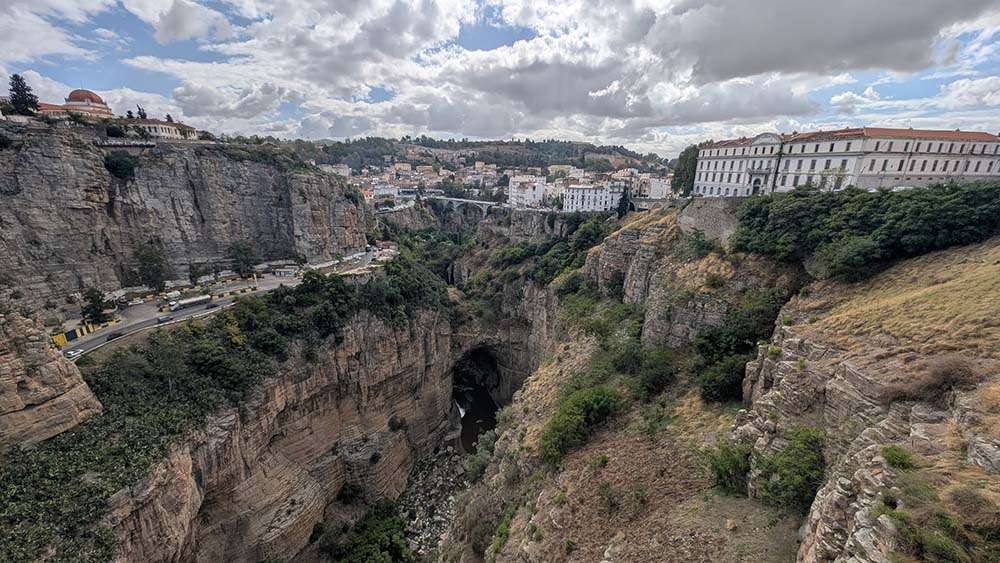
The dramatic Rhumel Gorge cutting through the city of Constantine, Algeria
Djemila
Another remarkable Roman archaeological site in Algeria is Djemila, a UNESCO World Heritage Site located in the mountains of northeastern Algeria. The ancient city was originally known as Cuicul and was founded by the Romans in the 1st century AD.
What makes Djemila unique is its dramatic setting. Unlike many Roman cities that were built on flat land, Djemila sits on a mountain plateau surrounded by hills and valleys. This location gives the ruins a particularly scenic atmosphere.
Visitors can explore the remains of temples, basilicas, forums and residential streets, many of which are still clearly visible today. Walking through the site allows you to see how a Roman provincial city was organised nearly two thousand years ago.
One of the most impressive structures is the Arch of Caracalla, built in honour of the Roman emperor. Nearby you can also find the Temple of Septimius Severus and the remains of the Christian basilicas, which show how the city continued to develop during the later Roman and early Christian periods.
The site also includes a museum displaying beautiful Roman mosaics, many of which were discovered during archaeological excavations in the area.
Because Djemila is less visited than many famous Roman ruins around the Mediterranean, visitors often have the opportunity to explore the site in relative peace and quiet. For history lovers, it is one of the most fascinating archaeological sites in Algeria.
Ghardaia (M’zab Valley)
One of the most unique places to visit in Algeria is Ghardaia, located in the M’zab Valley in the northern Sahara. This region is a UNESCO World Heritage Site and is famous for its distinctive desert architecture and centuries-old settlements.
The M’zab Valley is actually made up of five fortified towns, known locally as the Pentapolis. These towns were founded by the Mozabite Berbers around the 10th century and were carefully designed to adapt to the harsh desert environment.
What makes these towns so fascinating is their unique architectural layout. Houses are built close together and arranged around a central mosque that sits at the highest point of the settlement. Narrow streets and thick walls help protect residents from the intense desert heat.
Walking through Ghardaia feels very different from visiting Algeria’s coastal cities. The architecture, culture and pace of life are strongly influenced by the local Mozabite community, which follows its own traditions and religious customs.
One of the most striking cultural aspects visitors may notice is the traditional clothing worn by Mozabite women. Many wear a white garment known as a haïk, which covers the entire body and face so that only one eye remains visible. This distinctive style of dress is unique to the region and reflects the conservative traditions of the local community.
Another highlight of visiting the region is exploring the traditional markets, where locals trade spices, textiles, carpets and everyday goods. The markets offer a glimpse into daily life in the valley and are an important part of the local economy.
The surrounding desert landscapes also make the region visually striking. Palm groves, dry riverbeds and sandy plains surround the historic towns, creating a dramatic contrast between the green oasis areas and the vast Sahara beyond.
Because of its unusual architecture and cultural heritage, the M’zab Valley is considered one of the most distinctive historical regions in Algeria and offers travellers a completely different experience from the country’s Roman ruins or Mediterranean cities.
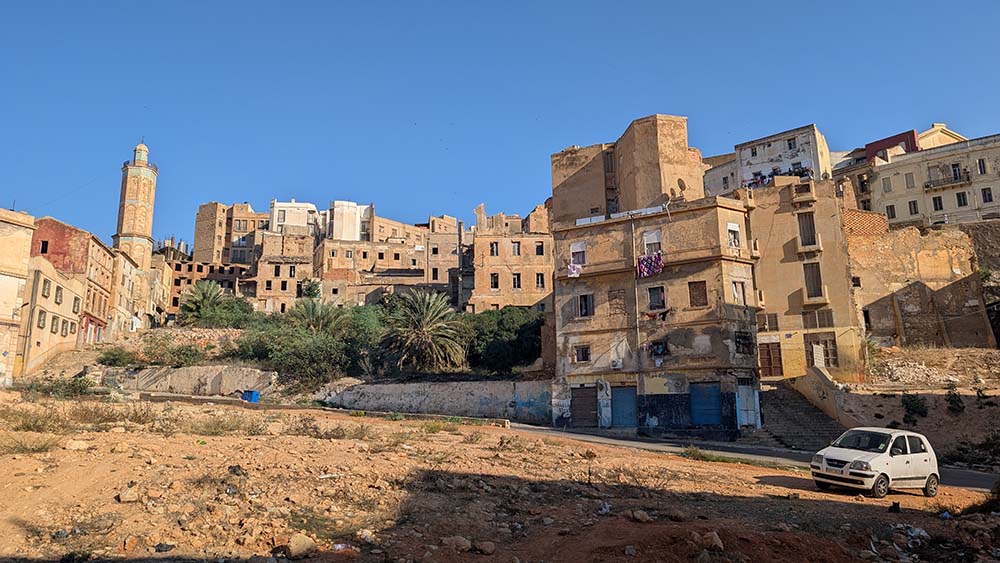
Traditional Mozabite architecture in Ghardaia, M’zab Valley, Algeria
Oran
The coastal city of Oran is Algeria’s second-largest city and one of the most vibrant destinations in the country. Located on the Mediterranean Sea in the northwest of Algeria, Oran is known for its lively atmosphere, colonial architecture and rich cultural history.
One of the most famous landmarks in the city is the Santa Cruz Fortress, which stands high on a hill overlooking Oran and the Mediterranean coastline. Built during the Spanish period in the 16th century, the fortress offers one of the most spectacular panoramic views in the region. From the hilltop, visitors can see the entire city, the harbour and the wide curve of the coastline stretching along the Mediterranean.
Near the fortress stands the Santa Cruz Chapel, another historic landmark perched above the city. The area around the fortress is one of the best viewpoints in Oran and a popular place to watch the sunset over the sea.
In the city centre, visitors can explore French colonial architecture, wide boulevards and lively squares that reflect Oran’s history under French rule. The city also has a strong cultural identity and is widely considered the birthplace of Raï music, one of Algeria’s most famous musical styles.
Another interesting site is the Fort of Mers El Kébir, located near the harbour, which has played an important role in the region’s military history.
Today, Oran combines Mediterranean scenery, historic landmarks and a vibrant urban atmosphere. For travellers exploring northern Algeria, it is one of the most interesting coastal cities to visit.
Where to Stay in Oran
Oran offers more accommodation options than many other cities in Algeria, but the overall selection is still relatively limited compared with typical tourist destinations. While there are several decent hotels available, the number of choices is far smaller than travellers might expect for a city of this size.
Most visitors will likely stay in mid-range hotels, which generally offer the best balance between comfort and price.
- Calypso Home
A comfortable and reasonably priced hotel in Oran offering modern rooms and a pleasant stay for travellers exploring the city. - Ibiris Hotel
A solid mid-range option with modern facilities and good comfort, making it a reliable choice for visitors staying in Oran. - Le Palme Hotel
Another good option in the city offering comfortable rooms and a pleasant atmosphere for travellers visiting Oran.
As with most cities in Algeria, it is still a good idea to book accommodation in advance, especially during busy travel periods.
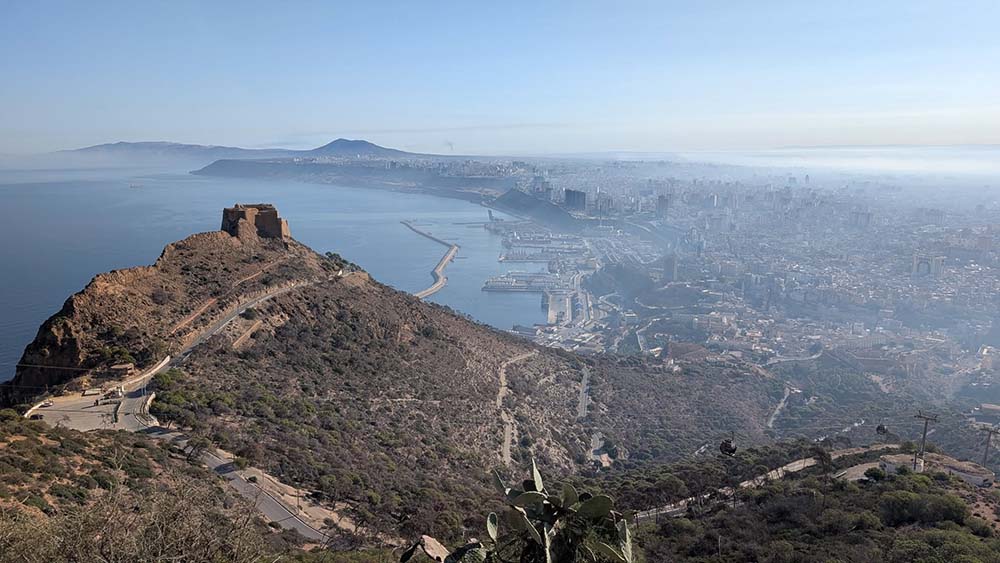
Santa Cruz Fortress overlooking Oran and the Mediterranean coast
Tipaza
Located about 70 kilometres west of Algiers, Tipaza is one of the most beautiful archaeological sites in Algeria. This UNESCO World Heritage Site combines ancient Roman ruins with stunning Mediterranean views, making it one of the most scenic historical locations in the country.
Tipaza was originally a Phoenician trading post before becoming an important Roman city during the first centuries of the Roman Empire. Today, visitors can explore extensive ruins scattered across a coastal plateau overlooking the sea.
Walking through the site, you can see the remains of Roman temples, villas, baths and a large amphitheatre. Many of the ruins are surrounded by pine trees and lie just a short distance from the Mediterranean coastline, creating a striking combination of history and nature.
One of the highlights of Tipaza is the Roman amphitheatre, which once hosted public events and performances. Another important structure is the Great Basilica, one of the largest early Christian churches in Roman North Africa.
Just outside the main archaeological site stands the Royal Mausoleum of Mauretania, a mysterious circular monument believed to be the tomb of King Juba II and Queen Cleopatra Selene, the daughter of Cleopatra and Mark Antony.
Because of its coastal setting and historical importance, Tipaza is often considered one of the most picturesque archaeological sites in Algeria and a popular day trip from Algiers.
Tassili n’Ajjer
One of the most extraordinary natural landscapes in Algeria is Tassili n’Ajjer National Park, a vast sandstone plateau located in the Sahara Desert in the far southeast of the country. The region is a UNESCO World Heritage Site and is considered one of the most remarkable desert landscapes in the world.
Tassili n’Ajjer is famous for its surreal rock formations shaped by millions of years of erosion. Wind and sand have sculpted the sandstone into arches, towers and natural stone forests that stretch across hundreds of kilometres of desert terrain.
Another reason the region is so important is its incredible collection of prehistoric rock art. More than 15,000 ancient carvings and paintings have been discovered in the area, some dating back over 10,000 years. These artworks depict animals such as giraffes, elephants and cattle, showing that the Sahara was once a much greener environment.
Exploring Tassili usually requires travelling by 4×4 vehicle and hiking through the desert, often as part of multi-day expeditions. Because of the remote location and the fragile environment, most visitors explore the area with local guides.
The nearby desert town of Djanet serves as the main gateway to Tassili n’Ajjer and is the starting point for most desert trips in the region.
With its dramatic landscapes and prehistoric heritage, Tassili n’Ajjer is widely considered one of the most spectacular places to visit in the Algerian Sahara.

Sahara desert landscape near Djanet, gateway to Tassili n’Ajjer
Djanet
Located in the far southeast of Algeria, Djanet is one of the most fascinating desert towns in the country and serves as the main gateway to Tassili n’Ajjer National Park. Surrounded by dramatic sandstone formations and vast Saharan landscapes, the town has become one of the most important starting points for desert expeditions in Algeria.
Djanet itself is a small oasis town, but its setting makes it incredibly special. Palm groves, rocky mountains and endless desert landscapes surround the settlement, creating one of the most striking environments in the Algerian Sahara.
The region around Djanet is famous for its spectacular rock formations, natural arches and vast sand dunes. Over millions of years, wind and erosion have sculpted the sandstone landscape into unusual shapes that make the area feel almost otherworldly.
One of the most memorable experiences near Djanet is travelling through the desert by 4×4 vehicle, exploring hidden valleys, prehistoric rock art sites and remote desert plateaus. Many visitors also spend nights camping in the Sahara, where the lack of light pollution creates spectacular views of the night sky.
The town is also home to the Tuareg people, whose culture has shaped life in the Sahara for centuries. Visitors can experience Tuareg hospitality, traditional tea ceremonies and desert cuisine while travelling through the region.
Because of its unique landscapes and cultural heritage, Djanet is widely considered one of the most beautiful desert destinations in Algeria and an essential stop for travellers exploring the Algerian Sahara.
Visitors should be aware that travelling independently into the desert around Djanet and Tassili n’Ajjer is not permitted. Access to most areas of Tassili n’Ajjer and the surrounding Sahara is restricted, and travellers must join organised expeditions with local Tuareg guides. These trips usually take place in 4×4 vehicles and can last several days, often including camping in the desert while exploring rock formations, prehistoric rock art and remote Saharan landscapes.
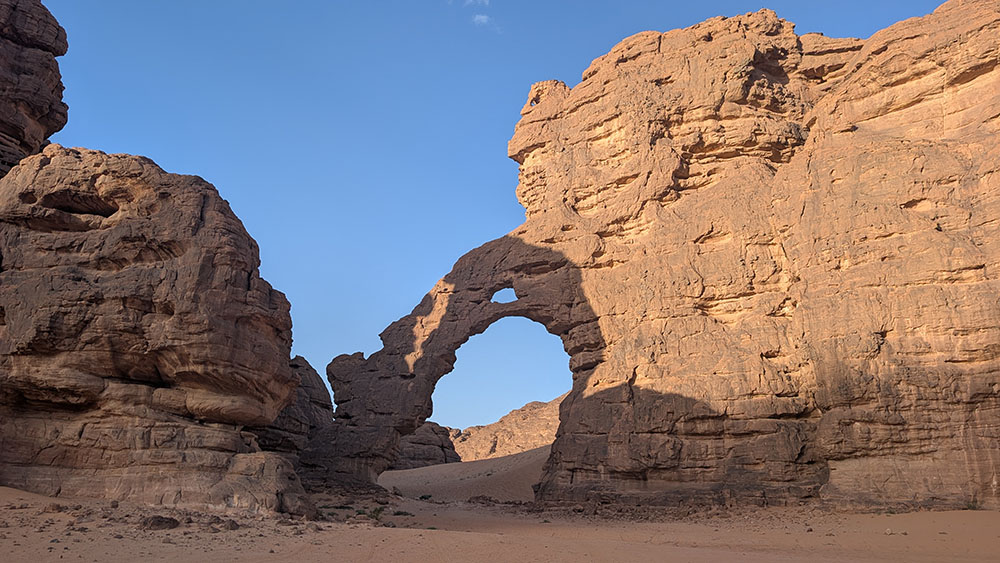
Sandstone rock arch in the Sahara near Djanet, Algeria
Tamanrasset
Located deep in the southern Sahara, Tamanrasset is one of the most remote and fascinating towns in Algeria. Often simply called “Tam” by locals, the city lies at the heart of the Hoggar Mountains (Ahaggar), one of the most dramatic desert landscapes in North Africa.
Unlike many places in the Sahara that are dominated by endless sand dunes, the region around Tamanrasset is known for its volcanic mountains, rocky plateaus and rugged desert scenery. The jagged peaks of the Hoggar range rise above the surrounding desert, creating landscapes that feel completely different from the classic sandy Sahara.
One of the most famous viewpoints in the region is Assekrem, a high plateau in the Hoggar Mountains known for its spectacular sunrises and sunsets. From here, visitors can see vast stretches of desert mountains and rocky valleys extending far into the horizon.
Tamanrasset is also an important cultural centre of the Tuareg people, the traditional nomadic inhabitants of the Sahara. Their culture, music and desert traditions remain an important part of everyday life in the region.
Because of its remote location and dramatic landscapes, Tamanrasset is often considered one of the most adventurous destinations in Algeria. For travellers exploring the Algerian Sahara, it offers a completely different perspective of the desert compared with the dunes around Djanet and Tassili n’Ajjer.
Hammam Essalihine
One of the most unusual historical sites in Algeria is Hammam Essalihine, also known as the Roman Baths of Khenchela. Located in eastern Algeria near the Aurès Mountains, this ancient thermal bath complex dates back to the Roman period, making it one of the oldest continuously used bathing sites in North Africa.
The most distinctive feature of Hammam Essalihine is its perfectly circular stone pool, which is fed by natural hot springs. The water emerges from underground at temperatures of around 70°C, making it extremely hot. Even in the pool the temperature remains very high, and bathing in it can be quite intense. Many visitors find it difficult to stay in the water for more than a short time.
The bath complex was originally built by the Romans, who were famous for constructing sophisticated thermal baths across their empire. Over time the structure was partially rebuilt and adapted, but the core design of the circular basin has remained remarkably intact.
Today, Hammam Essalihine is still used by locals who come to bathe in the warm mineral waters. The atmosphere is very different from modern spa resorts – the site feels authentic, simple and deeply connected to local daily life.
For travellers, the experience of bathing in a 2,000-year-old Roman thermal pool is something truly unique. Combined with the historic stone architecture and the surrounding landscape, Hammam Essalihine is one of the most fascinating hidden gems in Algeria.

Hammam Essalihine, ancient Roman thermal baths still used today in Khenchela, Algeria
Hammam Debagh (Cascade des Thermes)
One of the most unusual natural sights in Algeria is Hammam Debagh, also known as the Cascade des Thermes. Located near the city of Guelma in northeastern Algeria, this extraordinary site is famous for its steaming hot waterfalls and mineral-rich travertine formations.
Unlike typical waterfalls, the water flowing through Hammam Debagh comes from hot thermal springs deep underground. As the hot water cascades down the hillside, it deposits minerals that gradually form the white and golden terraces seen across the entire slope.
The result is a landscape that looks almost surreal. Layers of mineral deposits create formations that resemble frozen waterfalls, with hot water continuously flowing over them and steam rising into the air.
Visitors can walk across parts of the terraces and even bathe in some of the natural pools formed by the thermal waters. The site is particularly impressive in the early morning or late afternoon, when the sunlight highlights the different colours of the mineral formations.
Because of its unusual geology and steaming hot water, Hammam Debagh is considered one of the most unique natural attractions in Algeria and a fascinating stop for travellers exploring the northeastern part of the country.

Hot thermal waterfalls of Hammam Debagh (Cascade des Thermes), Algeria
Final Thoughts on Visiting Algeria
Algeria remains one of the most overlooked travel destinations in North Africa, yet it offers an incredible variety of landscapes and cultural experiences. From the Mediterranean cities of the north to the vast Sahara Desert in the south, the country is filled with places that feel far removed from mass tourism.
Travellers who make the effort to visit Algeria will discover ancient Roman cities, dramatic desert landscapes, historic towns and welcoming local communities. Many destinations still feel authentic and largely untouched compared with more popular countries in the region.
While travelling in Algeria may require a bit more preparation — especially when it comes to visas, transportation and desert travel — the reward is the opportunity to explore a country that very few international travellers have experienced.
For those looking for adventure, history and truly unique landscapes, Algeria is one of the most fascinating destinations in North Africa.
Frequently Asked Questions About Travelling to Algeria
Is Algeria safe for tourists?
Algeria is generally safe for travellers who stick to major cities and established tourist routes. Like in many countries, it is important to stay aware of your surroundings and follow local advice. Some remote desert regions require travelling with licensed guides, especially near the borders.
Do you need a visa to visit Algeria?
Most travellers need a visa to enter Algeria, which usually must be obtained in advance from an Algerian embassy or consulate. The process typically requires a passport, application form, photos and proof of accommodation such as a hotel booking.
What is the best time to visit Algeria?
The best time to visit Algeria is usually during spring (March to May) and autumn (September to November) when temperatures are more comfortable for travelling. Summers can be extremely hot, especially in the Sahara Desert.
Can you travel independently in the Sahara?
Independent travel in some desert areas is restricted. In regions such as Tassili n’Ajjer or the deserts around Djanet, travellers usually need to join organised trips with local guides and travel by 4×4 vehicles.
What currency is used in Algeria?
The official currency is the Algerian dinar (DZD). While official exchange offices exist, many travellers exchange money locally at better rates in major cities. Cash is widely used, and international cards are not always accepted outside larger hotels.